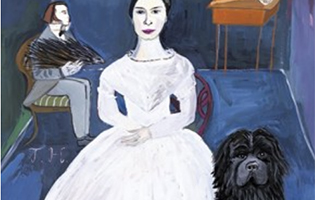
“You ask of my companions.
Hills, sir, and the sundown, and a dog as large as myself that my father bought me.
They are better than human beings, because they know but do not tell.”
Emily Dickinson, responding to Thomas Wentworth Higginson question in a letter, April 25, 1862: “Who are your companions?”

Emily Dickinson’s relationship with her Newfoundland dog, Carlo, was one of the most emotionally significant bonds of her life and left a subtle but meaningful imprint on her work.
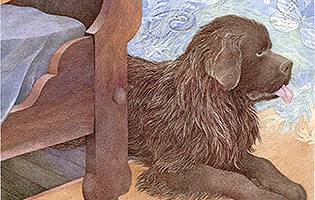
Carlo came to Dickinson in the mid-1850s, a gift from her father, and quickly became her constant companion during a period when she was withdrawing from public life. Large, gentle, and deeply loyal, Carlo accompanied her on daily walks around Amherst and the family homestead often the only excursions Dickinson regularly made. In letters, she refers to him with unmistakable affection and reliance, calling him her “keeper,” a word that suggests protection, steadiness, and emotional anchoring.
Carlo’s presence offered Dickinson unconditional companionship at a time when she was increasingly isolating herself from society and grappling with intense inner life. Unlike human relationships, which often felt demanding or disappointing to her, Carlo required no explanation, performance, or emotional negotiation. This freedom likely reinforced her retreat into solitude while making that solitude bearable and even generative.
When Carlo died in 1866, Dickinson was devastated. She wrote of being unable to cross certain thresholds without him and described her grief in stark, physical terms. His death coincides closely with a period of profound emotional intensity in her poetry, reinforcing how deeply his companionship had supported her daily life.
While Carlo does not appear directly as a named subject in her poems, his influence is felt in Dickinson’s recurring themes of loyalty, presence, loss, and wordless understanding, as well as in her attention to nature, walking, and companionship beyond human society. Carlo was not a muse in the traditional sense, but he was a stabilizing force that helped make Dickinson’s inward, fiercely original poetic life possible.
In short, Carlo was not just a pet: he was a constant, grounding relationship that shaped Dickinson’s emotional world, sustained her solitude, and left a quiet but enduring mark on her life and work.